 NetworkProgrammable
Preface: In healthcare, data kills. Or rather, the lack of data kills. Rare diseases are often misdiagnosed because no single hospital has enough cases to train an accurate AI model. We cannot pool the data due to HIPAA and GDPR. The solution is Federated Learning (FL) combined with Homomorphic Encryption (HE).
1. The Federated Learning Workflow
We deploy a "Compute Node" inside the firewall of each participating hospital. The workflow is cyclic:
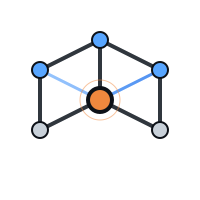
- Global Model Distribution: The central server sends the current model weights (W_global) to all 5 nodes.
- Local Training: Hospital A trains on its private MRI scans to produce W_local_A. Hospital B produces W_local_B.
- Update Encryption: Each hospital encrypts its gradients (the difference between W_global and W_local).
- Secure Aggregation: The central server averages the encrypted gradients. It cannot see the individual updates.
- Update Global Model: The averaged update is applied to W_global.
2. Differential Privacy (The Mathematics)
If a model is trained on a unique dataset (e.g., "Patient Zero" for a rare virus), it might memorize that patient's data. An attacker could query the model to extract this info.
We use Differentially Private Stochastic Gradient Descent (DP-SGD). Before sending the update, we clip the gradients (limiting how much influence one sample can have) and add Gaussian Noise.
# PyTorch Opacus Implementation
from opacus import PrivacyEngine

model = ResNet50()
optimizer = torch.optim.SGD(model.parameters(), lr=0.01)

privacy_engine = PrivacyEngine()

# Making the model private
model, optimizer, train_loader = privacy_engine.make_private(
    module=model,
    optimizer=optimizer,
    data_loader=train_loader,
    noise_multiplier=1.1, # Epsilon budget
    max_grad_norm=1.0,    # Clipping threshold
)

# Training loop remains standard, but gradients are noisy
for images, labels in train_loader:
    optimizer.zero_grad()
    output = model(images)
    loss = criterion(output, labels)
    loss.backward()
    optimizer.step()
3. Secure Multi-Party Computation (SMPC)
Even with noisy gradients, the server shouldn't see individual updates. We use Homomorphic Encryption or Secure Aggregation.
Imagine 3 people want to calculate their average salary without revealing their individual salaries.
- Person A splits their salary into 3 random numbers (shares) and gives one to B and C.
- B and C do the same.
- Everyone sums the shares they hold.
- Everyone reveals the sum. The sum of the sums is the total salary.
4. Network Infrastructure (SD-WAN)
Hospitals have strict firewalls. We utilize an SD-WAN Overlay to create a secure, private tunnel mesh between the compute nodes.
Topology: Hub-and-Spoke (Central Aggregator) or Peer-to-Peer (Decentralized Aggregation).
Bandwidth: Updating a 3D UNet model (500MB) across 20 sites requires optimization. We use Gradient Compression (sending only the top 1% of significant updates) to reduce traffic by 99%.
5. HIPAA Compliance Checklist
Federated Learning satisfies the "De-Identification" standard of HIPAA if implemented correctly.
- [ ] Data Sovereignty: PHI (Protected Health Information) never leaves the local disk.
- [ ] Audit Logs: Every training round is logged on an immutable ledger.
- [ ] BAA (Business Associate Agreement): Required for the infrastructure provider.
- [ ] Encryption At Rest: All local DBs encrypted.
- [ ] Encryption In Transit: TLS 1.3 for all parameter exchanges.
Conclusion: We no longer have to choose between patient privacy and medical progress. With Federated Learning, we can cure cancer collectively without ever seeing a single patient's file.